
- Published:
- Last Update: March 22, 2026
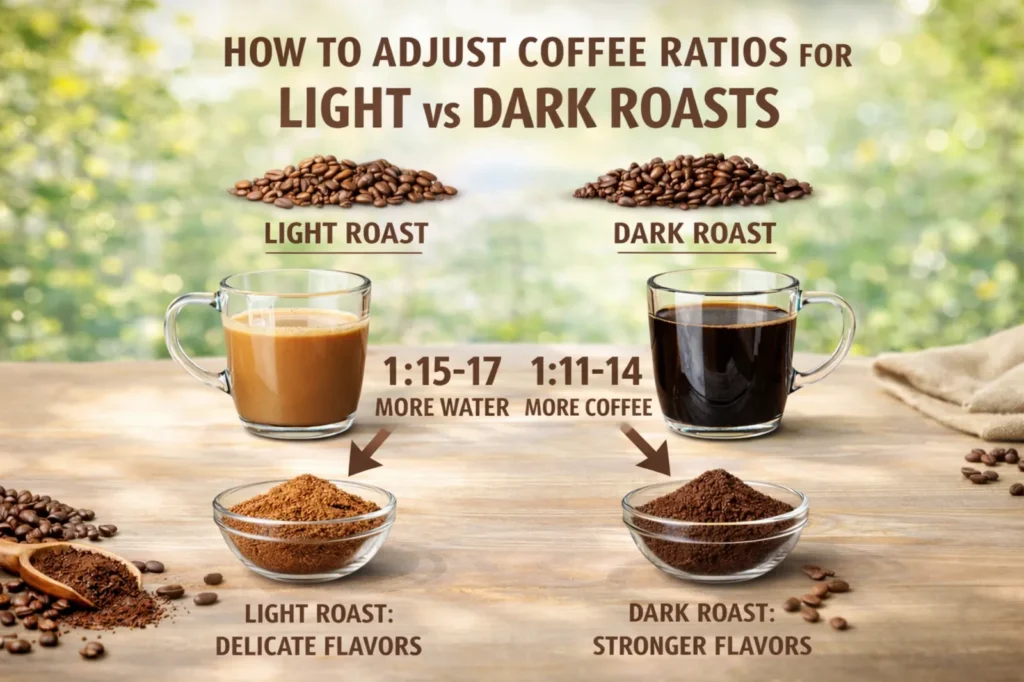
Not all coffee roasts extract the same way. A ratio that works perfectly for a dark roast may taste sour with a light roast. A ratio that balances a light roast may taste too strong or bitter with a dark roast.
Roast level changes how soluble the coffee is, how quickly it extracts, and how it behaves during brewing.
This guide explains how roast level affects extraction and shows you how to adjust coffee-to-water ratios for light, medium, and dark roasts across different brew methods.
If you’re new to ratios, start with Coffee-to-Water Ratios Explained for Beginners before adjusting for roast level.
How to use this guide
Roast level changes how quickly coffee extracts, which affects how your ratio behaves during brewing.
Keep your brew method consistent, then adjust the coffee-to-water ratio in small steps. Confirm grind size and brew time before making larger changes.
Why Roast Level Changes Extraction
Roasting changes the structure of coffee beans.
As roasting progresses, beans become more porous and easier to extract.
Light roasts:
- Are denser
- Extract more slowly
- Preserve acidity and origin character
Dark roasts:
- Are more porous
- Extract more easily
- Develop more bitterness and roast-driven flavors
Because dark roasts extract more quickly, they often need slightly different ratios than light roasts to stay balanced.
For a full baseline reference across methods, use your Coffee Brewing Ratios and Grind Size Chart (All Methods Explained) alongside this guide.
Standard brewing ranges are commonly used to guide ratio adjustments across different roast levels.
The Core Principle
Light roasts usually benefit from:
- Slightly stronger ratios (more coffee)
- Slightly longer extraction
Dark roasts usually benefit from:
- Slightly weaker ratios (less coffee)
- Controlled extraction to prevent bitterness
Small adjustments make a noticeable difference.
Even a 1–2 gram change in coffee dose can shift balance significantly.
Light Roast Ratio Adjustments
Light roasts highlight acidity, florals, and fruit notes. Because they extract more slowly, they can taste sour or thin if under-extracted.
Recommended Starting Ratios
Pour-over / drip:
1:15 to 1:16
French press:
1:13 to 1:14
Espresso:
1:2 to 1:2.5 yield
If Light Roast Tastes Sour
- Increase coffee dose slightly
- Extend brew time
- Grind slightly finer
For deeper troubleshooting, see Why Coffee Tastes Sour and How to Fix It.
Light roasts often need a little more extraction to unlock sweetness.
Medium Roast Ratio Adjustments
Medium roasts are balanced and forgiving. They respond well to standard ratios.
Recommended Starting Ratios
Pour-over / drip:
1:16
French press:
1:14
Espresso:
1:2
Medium roasts typically require minimal ratio adjustments unless you are dialing in for preference.
Dark Roast Ratio Adjustments
Dark roasts extract quickly and can become bitter if pushed too far.
Recommended Starting Ratios
Pour-over / drip:
1:16.5 to 1:17
French press:
1:14 to 1:15
Espresso:
1:1.8 to 1:2
If Dark Roast Tastes Bitter
- Slightly weaken the ratio
- Shorten brew time
- Lower brew temperature slightly
Lower temperatures can help reduce harshness and preserve balance.
Dark roasts often need less aggressive extraction to stay smooth.
Brew Method Considerations
Espresso
Light roast espresso:
- May benefit from slightly higher yield (1:2.5)
- Can require finer grind
Dark roast espresso:
- Often tastes better at tighter yields
- Can become harsh if extracted too long
Pour-Over
Light roast:
- Slightly stronger ratio
- Maintain good agitation
Dark roast:
- Slightly weaker ratio
- Avoid over-agitation
French Press
Light roast:
- Stronger ratio
- Ensure full extraction during immersion
Dark roast:
- Slightly lighter ratio
- Serve immediately after plunging
Cold Brew
Light roast:
- Slightly higher dose
- Longer steep if needed
Dark roast:
- Slightly lower dose
- Monitor bitterness closely
Quick Comparison Table
| Roast Level | Extraction Speed | Ratio Direction | Common Problem |
|---|---|---|---|
| Light | Slower | Slightly stronger | Sourness |
| Medium | Balanced | Standard ratios | Rare imbalance |
| Dark | Faster | Slightly weaker | Bitterness |
How Much Should You Adjust?
Keep adjustments small.
For most brew methods:
- Shift by 0.5–1 point in ratio
- Or adjust coffee dose by 1–2 grams
Large changes are rarely necessary.
Always taste before adjusting again.
Why Ratios Alone Do Not Fix Everything
Roast level also interacts with:
- Grind size (see Best Grind Size for Each Brew Method (With Visual Examples))
- Brew time
- Water temperature
If bitterness or sourness remains after ratio adjustment, revisit grind size first before making major changes.
If you’re unsure which variable to adjust first, see Brew Time vs Grind Size: What Actually Matters More?.
Frequently Asked Questions
Do light roasts always need stronger ratios?
Often yes, because they extract more slowly and can taste sour if under-extracted.
Often yes, because they extract more slowly and can taste sour if under-extracted.
Should I weaken the ratio for dark roasts?
Is ratio more important than grind size for roast adjustment?
Grind size still controls extraction speed. Ratio fine-tunes strength and balance.
Why does my light roast espresso taste thin?
Light roasts can taste thin in espresso when the shot is under extracted because the beans are denser and need more contact time. Make it less thin by grinding finer, using a slightly higher dose, and aiming for a longer shot time (or a slightly higher yield) until the flavor gets sweeter and fuller.
It may need a slightly stronger ratio or a higher yield.
It may be extracting too long or using too strong a ratio.
Can I use one ratio for all roast levels?
Yes, but adjusting slightly improves balance and sweetness.
Does roast level affect brew time?
It can. Light roasts sometimes benefit from slightly longer extraction.
It can. Light roasts sometimes benefit from slightly longer extraction.
Small shifts are best. Move gradually and taste carefully.
Final Brewed Within Tip
Roast level changes how coffee behaves in water. Light roasts often need a little more push. Dark roasts often need a little restraint. Small ratio adjustments bring out the best in each roast without overcomplicating your brew.
Related Coffee Brewing Guides
Deepen your understanding of brewing fundamentals with these supporting guides:
- Coffee Brewing Ratios and Grind Size Chart (All Methods Explained) – Master the core variables behind balanced extraction.
- Coffee-to-Water Ratios Explained for Beginners – Learn how ratios control strength and balance.
- Best Grind Size for Each Brew Method (With Visual Examples) – Match grind texture to your brewing style.
- Brew Time vs Grind Size: What Actually Matters More? – Understand how extraction speed and contact time interact.
- Why Coffee Tastes Sour and How to Fix It – Solve under-extraction and sharp flavor issues.
- Why Your Coffee Tastes Bitter (By Brew Method) – Fix harsh or over-extracted coffee.
